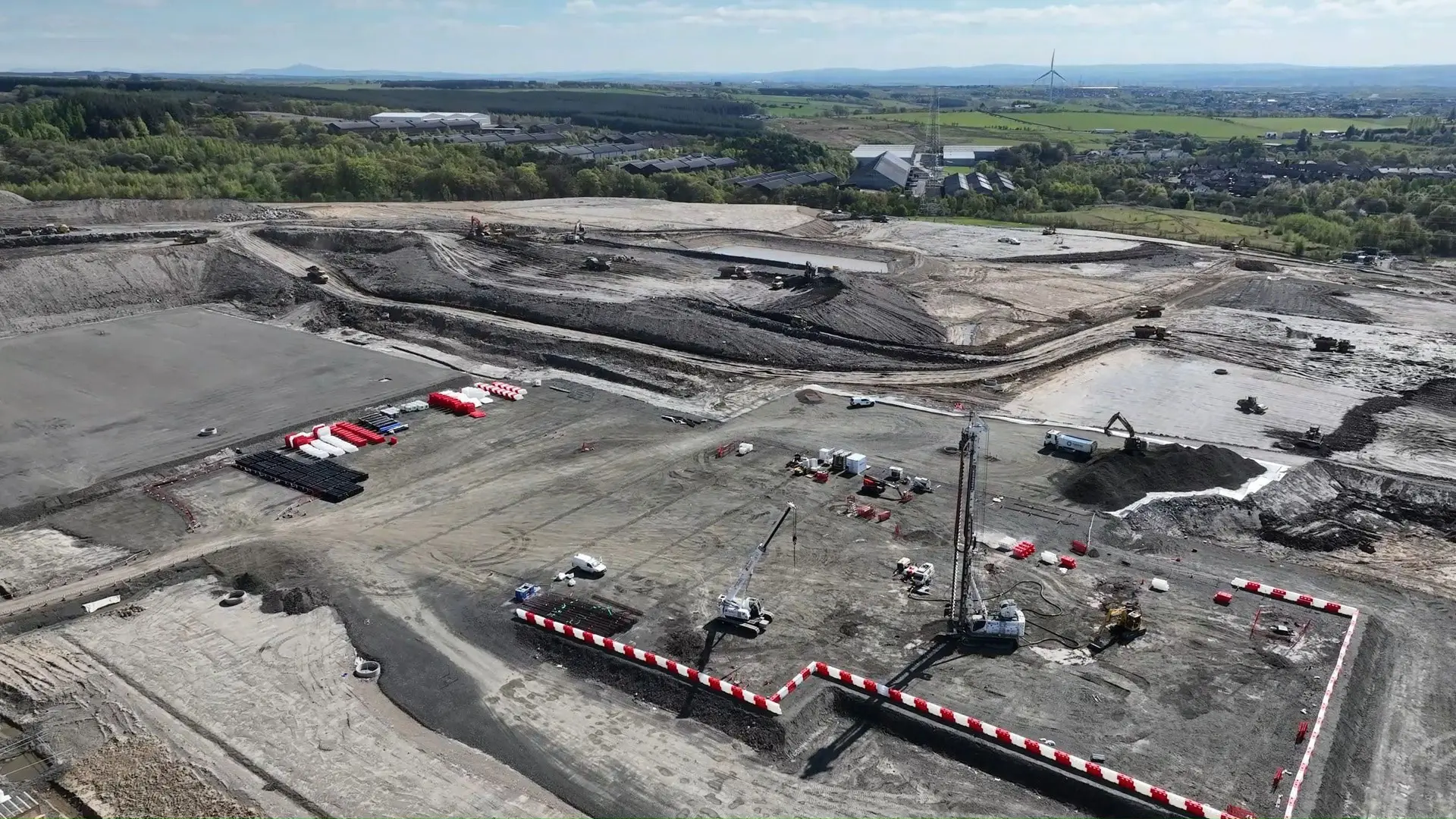
You may have noticed a new machine on site recently and wondered what is happening. This work forms part of early investigations for future development, known as test piling. It is an important step that allows engineers to better understand the ground conditions below the surface before any permanent construction begins. Carrying out this work early helps ensure future foundations are designed safely, efficiently, and with minimal disruption.
What is piling and why is it needed?
Piling is a construction technique where long concrete and steel elements are installed deep into the ground to support a building. Some sites, such as Monklands Replacement Project, require foundations that reach stronger ground below the surface. Once installed, piles work with the surrounding ground through a combination of skin friction along their length and end bearing at their base, providing a safe and stable foundation. They are typically used when the engineer has calculated that the ground near the surface is not suitable to safely support a structure.
Why do we need to do test piling?
The ground beneath the site is made up of several layers, including mudstone, and a very hard volcanic rock called dolerite. These conditions are more complex than those found on typical construction sites.
The purpose of the test piling is to confirm that it is feasible to install deep foundation piles safely and effectively into these ground layers, giving both designers and contractors greater confidence before permanent piling works begin. By drilling into the top of the dolerite rock layer and mudstone layer to the prescribed pile lengths using both rotary bored piling (RBP) and continuous flight auger (CFA) techniques, we can:
- Confirm how drilling behaves when it reaches very hard rock
- Understand how deep piles need to be installed to safely support future structures
- Reduce uncertainty and risk later in the project
What are we testing for?
The test piling is designed to answer key technical elements, including:
- Verify how piles behave when installed into dolerite rock and mudstone, including what depth is required to achieve the necessary strength
- Assess bore stability and groundwater conditions to ensure safe construction methods are selected
- Provide more certainty to the project and advance insight
What machine is being used?
The works are being carried out using a BAUER BG36 piling rig. This is specialist equipment well‑suited to the site geology, designed for deep piling works and extremely hard ground conditions. It allows the work to be completed as efficiently and safely as possible.
When do we expect the testing to be complete?
The test piling is being carried out in two stages:
- Stage 1 – The initial drilling works are now complete. The next step is a static load test, which will measure how the test pile performs when load is applied. This is a low‑noise activity and confirms if the pile design works as expected in the dolerite rock area
- Stage 2 – A second phase of testing will take place once a suitable area and rock socket becomes available to test slightly different ground conditions, including mudstone. Where possible, this stage will be combined with permanent piling works to help minimise disruption